On this page
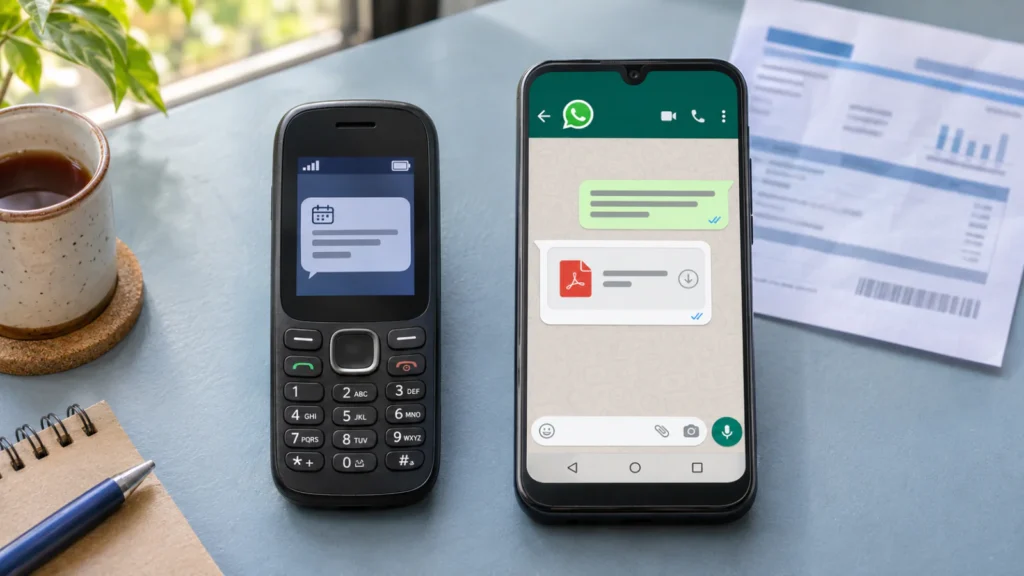
A water bill that arrives on WhatsApp with a PDF statement and a pay button gets paid. The same bill sent only on WhatsApp to a customer with a basic phone never arrives at all.
The choice between SMS and WhatsApp is not about which is better. It is about which one reaches this customer, for this message, at the lowest cost. Here is how to decide.
What each channel does well
| SMS | ||
|---|---|---|
| Reach | Every phone, including basic phones | Smartphones with WhatsApp and data |
| Needs data | No | Yes |
| Sender shown | Your sender ID, such as RIVERSIDE | Your business name and profile |
| Length | 160 plain characters per part | Long messages in one bubble |
| Documents and images | No | PDFs, images and locations |
| Buttons | No, a link at most | Quick replies and call-to-action buttons |
| Replies | Not to an alphanumeric sender ID | Yes, in the same chat |
| Rules for starting a message | Your sender ID and consent rules | An approved template outside the 24-hour window |
Where SMS wins
One-time codes. A sign-in code has to arrive in seconds on any phone, whether or not the customer has data. SMS is the safe default.
Customers on basic phones or without data. Older customers, rural customers and anyone out of bundles still get an SMS. A reminder that never arrives collects nothing.
Short, urgent notices. A water interruption, a payment received or a delivery at the gate fits in one SMS and needs no attachment.
Where WhatsApp wins
Statements and invoices. A PDF statement, an itemised bill or a receipt with a logo reads properly on WhatsApp and can be saved or forwarded.
Anything that starts a conversation. “Your rent is due on Friday” on WhatsApp lets the tenant reply “Can I pay half now?” in the same chat. A person or an assistant can answer there.
Buttons. “Pay now”, “Talk to us” or “Confirm” buttons cut the steps between reading and acting.
Customer service. When a customer writes first, you can reply in full for the next 24 hours. Our guide to the WhatsApp Business API in Kenya explains the window and how Meta prices each type of message.
How each one is charged
SMS is charged per part. A message up to 160 plain characters uses one part, and longer messages use more. An emoji or curly quote cuts each part to 70 characters, which is why plain characters matter.
WhatsApp on the Business Platform is charged by Meta per message, by category: marketing, utility for things such as bills and receipts, and authentication for codes. Marketing costs the most. Every message you start outside the 24-hour window must use a template that Meta has approved in advance.
The practical difference: SMS cost depends on message length and count. WhatsApp cost depends on the category of each message and on whether the customer wrote first.
Use both
The businesses that reach everyone do not choose. They send on one channel and fall back to the other:
- Send bills, statements and reminders on WhatsApp first, with the PDF and a pay button.
- If the WhatsApp message cannot be delivered, because the number is not on WhatsApp or the template fails, send a short SMS with the amount, due date and pay details.
- Send one-time codes by SMS, where speed and reach matter most.
- Send email as well where you have it, at no cost, for the customer’s records.
That way the smartphone customer gets the rich version, the basic-phone customer still gets the essentials, and nobody misses a bill because of the channel you chose for them.
Getting set up
You need two things: a sender ID with SMS units for SMS, and a number connected to the WhatsApp Business API with approved templates for WhatsApp. Our guide to getting a sender ID in Kenya covers the first.
We provide both as one bulk SMS and WhatsApp service: we register your sender ID, top up your SMS units and connect your WhatsApp number. Our own products use it to send bills, confirmations and reminders, including BillGrid for billing and Noria PMS for rent.
Need it built properly? A free 30-minute call with an engineer, then one fixed price in writing.
Book a free call