On this page
- TL;DR
- 1. Who registers my sender ID, and on which networks?
- 2. Can I send before my sender ID is approved?
- 3. Do I get delivery reports for every message?
- 4. Do units expire?
- 5. How do I top up, and what happens when I run out?
- 6. Is there an API, and is it documented?
- 7. What happens when a message fails?
- 8. Can the same provider send WhatsApp?
- 9. How do you handle opt-outs?
- 10. Who do I call when it breaks?
- A simple scorecard
- Where we fit
Most businesses choose a bulk SMS provider on one number: the rate per SMS. Then the first bill run goes out under a random number, and half the messages show “sent” with no proof they arrived. The units bought in bulk expire before the second term.
The rate matters. These ten questions matter more.
1. Who registers my sender ID, and on which networks?
Your sender ID is the name customers see. Ask who handles the registration, what you need to provide and which networks it covers. Safaricom approves sender IDs separately from other networks, so a provider that is quick on Airtel but slow on Safaricom leaves most of your customers waiting. Our guide to getting a sender ID in Kenya explains the process.
2. Can I send before my sender ID is approved?
Approval can take from days to weeks. Ask whether you can start under the provider’s own sender ID in the meantime, so a launch is not held up by paperwork.
3. Do I get delivery reports for every message?
“Sent” means the provider accepted it. “Delivered” means it reached the phone. Ask for a delivery report on every message, so you can see which customers received the bill and which numbers are wrong, off or no longer in use.
4. Do units expire?
Some bundles expire after a set period. A school that buys units for the year and sends most of them in three peaks needs units that last. Ask in writing.
5. How do I top up, and what happens when I run out?
You should be able to top up quickly, without an invoice cycle. Ask what happens to messages when the balance hits zero. The right answer is that they wait and go out once you top up, not that they fail silently.
6. Is there an API, and is it documented?
If your billing system, school system or app will send messages, you need an API your developers can use from any language. Ask for the documentation before you buy, and have your developer read it. An API that is hard to use costs more in development time than you save on the rate.
7. What happens when a message fails?
Networks have outages. Ask whether failed messages are retried, how you find out about the ones that never went through, and whether you can resend only those. A provider that cannot answer clearly will leave you guessing during your busiest week.
8. Can the same provider send WhatsApp?
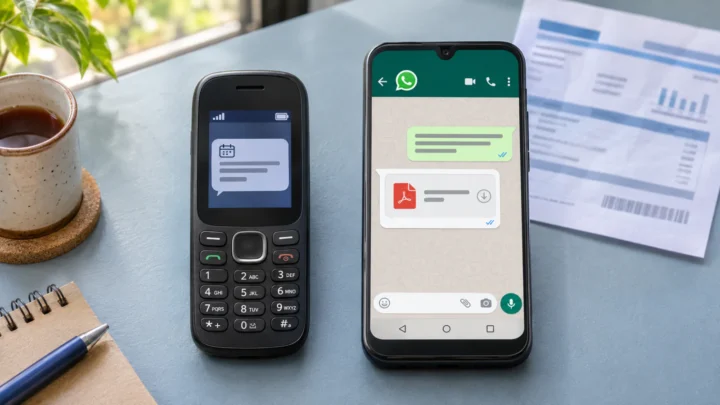
Bills and statements often work better on WhatsApp, with a PDF and a pay button, while codes and reminders to basic phones need SMS. Our comparison of SMS and WhatsApp for bills covers which to use when. One provider for both means one account, one balance and one place to look when something goes wrong.
9. How do you handle opt-outs?
Promotional SMS in Kenya needs consent and a working opt-out under the Data Protection Act 2019. Ask how opt-outs are captured and whether they are applied automatically to your future sends. Our guide to consent and opt-out explains what the law expects.
10. Who do I call when it breaks?
Ask for a named way to reach support: a phone number or a WhatsApp number answered by people who can see your account. A ticket form answered in three days is no help when a fee reminder to 2,000 parents has not gone out.
A simple scorecard
| Question | Good answer |
|---|---|
| Sender ID | They register it, on every network, and tell you what to prepare |
| Before approval | You can send under their sender ID meanwhile |
| Delivery reports | On every message |
| Unit expiry | Units that do not run out before you use them |
| Running out | Messages wait for a top-up, never vanish |
| API | Documented, plain HTTP, any language |
| Failures | Retried, reported and resendable |
| Same provider, same account | |
| Opt-outs | Captured and applied automatically |
| Support | People you can call or message |
Where we fit
We run our own bulk SMS and WhatsApp service because our products need it. BillGrid sends bills and receipts, SiteBoss sends payment confirmations and approvals, and Noria PMS sends rent bills and reminders. We register your sender ID, provide SMS units and connect your WhatsApp number, with APIs for your own systems. Ask us the ten questions above before you buy, and we will answer each one plainly.
Need it built properly? A free 30-minute call with an engineer, then one fixed price in writing.
Book a free call