On this page
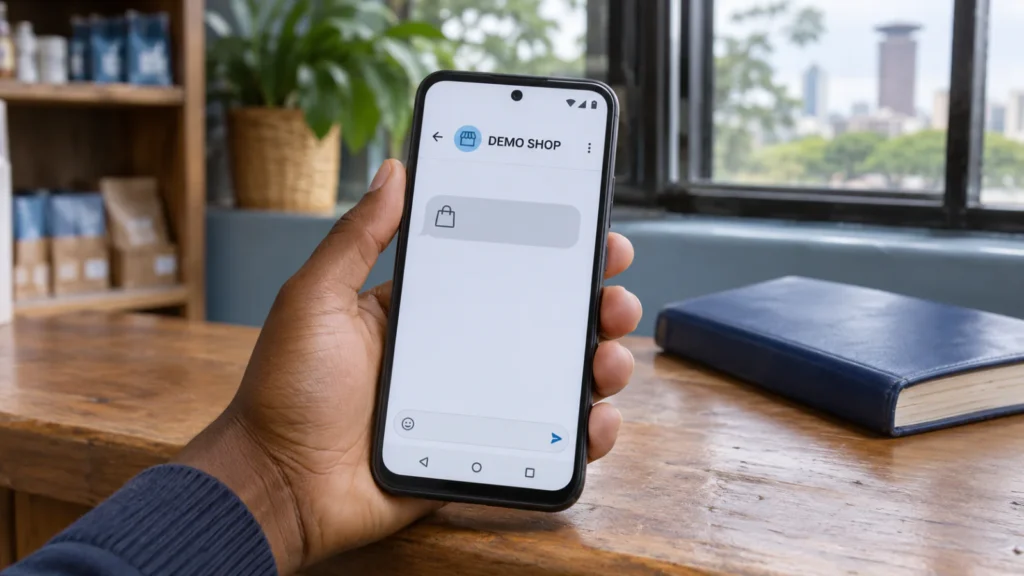
A bill from “0722 xxx 118” looks like a scam. The same bill from “RIVERSIDE” looks like your landlord. That one difference, the name above the message, decides whether customers open your SMS, trust the pay link inside it, or delete it unread.
That name is your sender ID. Getting one in Kenya is not hard, but it is slower than most businesses expect, and a refused name sends you back to the start.
What a sender ID is
A sender ID, also called an alphanumeric sender ID, is the name that appears as the sender of an SMS in place of a phone number. Banks, utilities, schools and shops use them so customers know who is writing before they read a word.
Customers cannot reply to an alphanumeric sender ID. If you need replies, ask for them in the message, through a WhatsApp link, a phone number or a pay link, or use a separate number for two-way chat.
Pick a name the networks will accept
Most refusals come from the name itself. Before you apply, check yours against these rules:
- 11 characters at most. Use letters and digits, and avoid spaces. “RIVERSIDE” works. “RIVERSIDE COURT APARTMENTS” does not.
- Your brand, not a word. Generic names such as INFO, SMS, ALERT or NOTICE are refused, because anyone could claim them.
- A name you can prove. The network will ask whether the name belongs to you. A registered business name or trademark that matches makes it easy.
- Not someone else’s brand. A name close to a bank, a telco or a well-known company will be questioned or refused.
If your full name is too long, shorten it the way customers already say it. “Greenhill School” becomes “GREENHILL”. “Mama Mboga Fresh” becomes “MAMAMBOGA”.
Who approves it
Businesses do not register sender IDs with the networks directly. Registration goes through a licensed bulk SMS provider, who submits it to each network on your behalf.
Safaricom approves sender IDs on its own, separately from Airtel and Telkom. A name approved on one network can still be pending on another. Since most of your customers are likely on Safaricom, its approval is the one that decides when you can start.
Approval can take from a few days to a few weeks, depending on the network and how complete your application is. Plan for that time before a launch, a new term or the first bill run, not the week of it.
What to prepare
Requirements vary slightly between providers and networks. Most ask for:
| Item | Why they ask |
|---|---|
| Certificate of incorporation or business registration | Proves the business exists |
| The sender ID you want, and one or two backups | Saves a second round if the first is refused |
| A letter authorising the provider to register the name for you | Shows you own the name and agree to its use |
| Sample messages you will send | Shows what kind of traffic it carries |
| The type of traffic: bills, codes, alerts or promotions | Networks treat transactional and promotional messages differently |
| Your expected monthly volume | Helps the network plan and spot abuse |
Write the sample messages as real ones, with real amounts and links. “Hi Wanjiru, your May bill for unit B4 is KSh 20,650. Pay on paybill 123456” tells the reviewer far more than “We will send our customers updates”.
Mistakes that cause delays
- Applying with a generic name. It comes back refused, and you start again.
- Mismatched names. A sender ID that matches neither your registered name nor a trademark invites questions.
- Vague samples. Reviewers approve traffic they can picture.
- Mixing promotions into a transactional sender ID. Tell your provider honestly what you will send. Networks act on complaints, and a name used for unexpected promotions can be suspended.
- Leaving it to the last week. The bill run cannot wait for an approval that is still in a queue.
After approval
Use the name the same way every time, so customers learn it. Put your business name or the unit, account or order number in the first line, so the message makes sense in a crowded inbox. Keep messages short enough to fit in one SMS where you can, which our guide to bulk SMS that customers read covers in detail.
If you would rather not handle the paperwork, we register sender IDs for businesses as part of our bulk SMS and WhatsApp service. We tell you early if a name is likely to be refused and prepare the application with you. Then we set up your SMS units, so your first message goes out under your own name.
Need it built properly? A free 30-minute call with an engineer, then one fixed price in writing.
Book a free call