On this page
Bulk SMS is the fastest way to reach every customer, smartphone or not. It is also the fastest way to annoy them. Send a promotion to someone who never asked, at 10pm, in three parts, and you lose the customer and may hear from the regulator.
Four habits separate the businesses whose messages get read from the ones that get blocked: knowing what needs consent, offering a real way out, timing, and length.
Two kinds of message
Most of what a business sends falls into one of two groups, and the rules differ.
| Transactional | Promotional |
|---|---|
| Bills and statements | Offers and discounts |
| Payment confirmations and receipts | New products and services |
| One-time codes | Event invitations |
| Delivery, appointment and due-date reminders | Seasonal campaigns |
| Account and security alerts | Anything meant to sell |
Transactional messages are part of a service the customer already uses. They expect them, and they would complain if they stopped. Promotional messages are direct marketing, and Kenya’s Data Protection Act 2019 treats them differently.
Consent for promotions
Under section 37 of the Data Protection Act 2019, using someone’s personal data for direct marketing, including their phone number for promotional SMS, needs a lawful basis. For most businesses that basis is consent.
Consent means the customer agreed, clearly, to receive marketing from you. The Office of the Data Protection Commissioner (ODPC) has found that a customer paying by M-PESA had not, by paying, agreed to receive marketing. Having someone’s number is not the same as permission to sell to them.
Collect consent where customers already deal with you:
- a tick box on your sign-up or checkout form, unticked by default
- a line on your registration form: “Send me offers by SMS”
- a keyword customers text to join, such as “JOIN”
Record when and how each person agreed. If a complaint ever reaches the ODPC, that record is your answer.
An opt-out that works
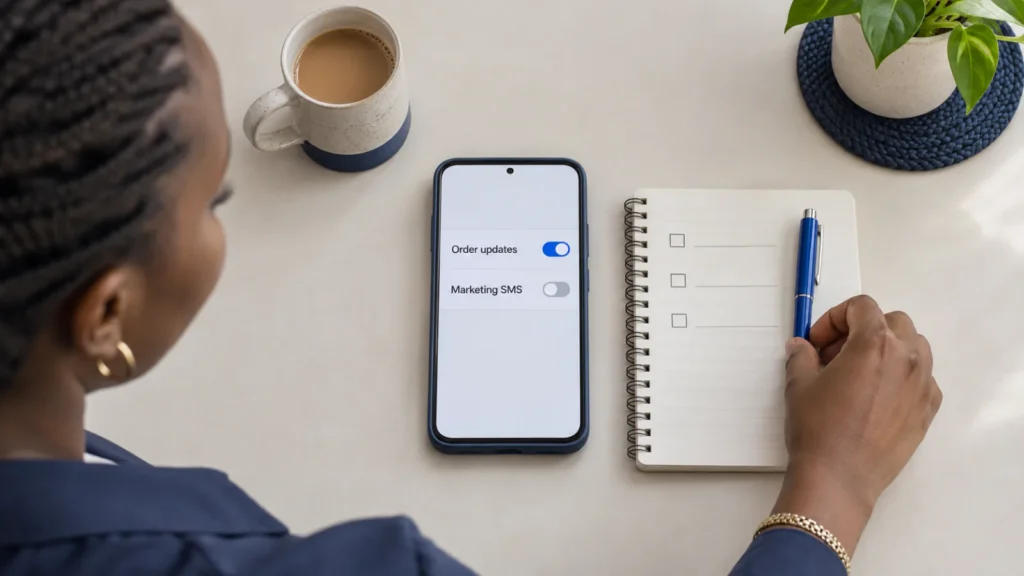
The Data Protection (General) Regulations 2021 require a clear and accessible way to opt out of direct marketing. Replying with a single word is the common way.
Put it in every promotional message, in plain words: “Reply STOP to opt out.” Then make it work:
- Honour it at once. Remove the number before the next send, not at the end of the month.
- Keep one list. A customer who opts out from one campaign has opted out of all your promotions.
- Keep the service messages. Opting out of promotions does not stop their bills, receipts or codes, and they should know that.
- Never re-add a number from an old list after the person asked to leave.
The ODPC has ruled against businesses that kept messaging people after they asked to stop, and against businesses that could not show their opt-out worked. A missing opt-out is the easiest complaint to lose.
Send at the right time
Transactional messages should arrive when they are useful. The receipt comes within a minute of payment, the code the moment it is requested, and the reminder a few days before the due date.
Promotions belong in daytime hours. A campaign at 9am on a weekday is read. The same campaign at 11pm is resented, and resentment turns into complaints and blocked numbers.
Fit the message in one SMS
A single SMS holds 160 characters of plain text. Longer messages are split into parts of 153 characters each, and each part uses units.
That limit falls to 70 characters, and 67 per part, the moment a message contains a character outside the basic SMS alphabet. The usual culprits are easy to miss:
- an emoji
- curly quotes and apostrophes copied from a word processor
- an en dash or em dash in place of a hyphen
- some accented letters
A 150-character bill with one curly apostrophe becomes a three-part message. Across 5,000 customers, that is 15,000 parts in place of 5,000.
Write the important part first, in case the message is cut short on an old phone:
RIVERSIDE: Hi Wanjiru, May bill for B4 is KSh 20,650, due 5 May. Pay on paybill 123456, account RC-B4. Thank you.
That is 113 plain characters: one SMS, with everything the tenant needs.
The short version
- Send service messages freely, and promotions only to people who agreed.
- Put “Reply STOP to opt out” in every promotion, and honour it at once.
- Time messages for when they help, never late at night.
- Write in plain characters and keep each message to one SMS.
Our bulk SMS and WhatsApp service gives you your own sender ID and SMS units, and we help you set up consent and opt-out handling before your first campaign. If you are still choosing a name, start with our guide to getting a sender ID in Kenya.
Need it built properly? A free 30-minute call with an engineer, then one fixed price in writing.
Book a free call