On this page
An AI WhatsApp chatbot that answers wrongly costs more than having none. It quotes last month’s price, promises a delivery date nobody agreed or tells an angry customer their payment “will reflect soon”. The customer screenshots the reply, and that answer is now your policy.
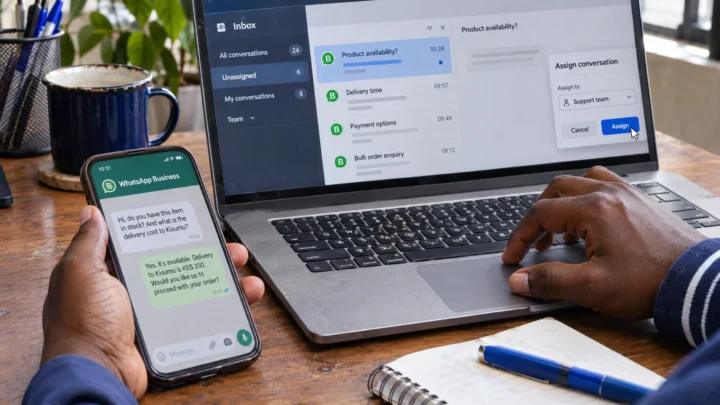
Done well, an assistant drafts the answers to repeated questions in seconds, a person sends them with one tap, and the hard chats arrive with the context attached. The difference lies in three decisions made before launch: what it may answer, what it must hand over and where its answers come from.
Sort every question into three lists
Go through a month of real chats and sort each question type into one of three lists. Most businesses find the first list is long and the third is short but expensive.
| Draft it, a person sends with one tap | Draft it, a person edits and sends | Hand to a person at once |
|---|---|---|
| Opening hours, location and delivery areas | Quotes for custom or bulk orders | Payment disputes and missing payments |
| Prices and availability from the catalogue | Replies to unhappy customers | Complaints and threats to leave |
| Order status from your order system | Exceptions to the returns policy | Refund requests |
| How to pay, with the right paybill or an STK prompt | Requests for credit or a payment plan | Anything about health, safety or the law |
| The returns policy as written | Follow-ups on a lapsed order | A customer asking for a person |
| Booking or appointment slots | Anything it cannot check in your data |
The first list holds facts your records already contain, so the draft is usually right. The second holds judgement calls where a draft saves time but a person rewrites it. The third holds the chats where a wrong word costs a customer or money.
Hand over anything it cannot check
One rule covers most of the risk. If the answer is not in your data, the assistant says a person will reply, and a person does.
Payment questions show why. “I paid but it has not reflected” can be checked: the assistant looks for the M-PESA or bank receipt against the order. If your system shows the payment, it drafts that answer for a person to send. If it does not, the chat goes to a person, because only a person should tell a customer what happened to their money.
The same applies to refunds, delivery promises and anything outside your stated policy. The assistant never promises a refund, never sets a new date and never offers a discount.
A handover needs three things to work:
- The person receives the full chat, the order number and the reason for the handover.
- The customer hears who will reply and roughly when, such as “within 30 minutes during working hours”.
- Out of hours, an away message you approved in advance gives the real reply time instead of pretending someone is there.
Meta’s Business Messaging Policy makes this a requirement. A business using automation must offer prompt, clear and direct escalation paths, such as an in-chat transfer to a person, a phone number, email or a support form.
Ground every answer in your own data
A general AI model knows nothing about your prices, stock or delivery zones. Left to itself, it fills the gap with something that sounds right.
Point it at your own sources instead:
- the catalogue and price list, from the same place your website reads them
- delivery zones, fees and cut-off times
- the returns, exchange and warranty policy as written
- order and payment records, read-only
- the questions your team answers every week, with the approved answers
Log the source behind every answer, so a person reviewing the chat can check it. When a price changes, update the source that day. An assistant reading last week’s price list is wrong with full confidence.
Limit what it can do as tightly as what it can say. Reading an order’s status is fine. Changing an order, issuing a refund or altering a price belongs with a person.
Send the model only the data each answer needs. Kenya’s Data Protection Act 2019 applies to your customers’ details, so ID numbers and full payment histories have no place in a prompt.
Follow Meta’s rules for AI on WhatsApp
Meta’s terms for the WhatsApp Business Platform include a section on AI providers. Providers and developers of AI may not use the Platform where AI is the primary function on offer, rather than incidental or ancillary. Meta decides which side a use falls on, at its sole discretion.
The terms target general-purpose assistants offered over WhatsApp. An assistant that answers your own customers about your own orders is AI in support of your business, not the product itself. Keep it focused on your business, and keep that focus clear in how you describe it.
The same terms bar using Platform data to build or train AI models. The exception is fine-tuning a model for your exclusive use. Check that your AI vendor does not use your chats to train its general models.
The usual WhatsApp rules still apply. Free-form replies work inside the 24-hour window after the customer’s last message. Outside it, every message needs an approved template. From 1 October 2026, Meta charges for service replies beyond 1,000 a month per number, so a chatty assistant now has a cost per message. Our WhatsApp Business API guide covers templates and categories.
Measure it every week
An assistant that nobody reviews drifts. Prices change, policies change and the answers stay the same.
| Measure | What it tells you |
|---|---|
| Wrong answers in a weekly sample of 50 chats | Whether customers can trust it |
| Handoff rate, by reason | Which questions it should not take on |
| Time from handoff to a human reply | Whether the handover works in practice |
| Customers asking for a person twice or more | Where it loops instead of handing over |
| Drafts sent without edits | How much time it saves |
| Messages per resolved chat | What each chat costs on Meta’s pricing |
Read the wrong answers first. A high share of unedited drafts means little if one answer in ten is wrong.
Start with edits, then speed up approval
Launch with every reply drafted by the assistant and sent by a person. Two to four weeks of drafts show which question types it answers right without edits.
Move those types to one-tap approval one at a time, so a person still sends every reply but no longer rewrites it. Keep the third list with people permanently. Our guide to taking WhatsApp orders shows where the assistant fits in an order flow.
Your next step
Export a month of WhatsApp chats and sort the questions into the three lists above. Count how many fall on the first list. That count is the work an assistant can take on safely.
Our WhatsApp and AI automation service sorts incoming chats by urgency and drafts replies from your own records for a person to approve. To talk through your list, book a free scoping call.
Need it built properly? A free 30-minute call with an engineer, then one fixed price in writing.
Book a free call