On this page
Kenya’s new electricity market rules provide for power producers to sell electricity in bulk directly to eligible consumers, not only through Kenya Power. For a producer, that is a new market. It is also a new job: electricity billing for many customers instead of one.
This is what the rules say, where they stand in Parliament, and the billing a producer needs before the first direct contract.
What the rules say
The rules are the Energy (Electricity Market, Bulk Supply and Open Access) Regulations, 2026, published as Legal Notice No. 79 in Kenya Gazette Supplement No. 115 of 8 May 2026. The full text is on EPRA’s website.
Under regulation 24, an eligible consumer may buy electricity in bulk from a generation licensee for its own use. The Energy and Petroleum Regulatory Authority must first approve the bulk supply contract. The consumer’s load must be at least 1 MVA on the distribution network or 10 MVA on the transmission network. A generation licensee may also supply in bulk to another licensee for resale.
Market participants trade through a bilateral contract, a spot market or a forward contract (regulation 7). The companies that own the lines charge wheeling charges, use-of-system charges or both (regulation 37), and bill them under a wheeling agreement (regulation 38).
Where they stand in Parliament
On 19 November 2026, the National Assembly’s Committee on Delegated Legislation conditionally approved the regulations, as Kenyans.co.ke and Kenya Today reported.
Nairobi News reported the conditions. EPRA is to incorporate the committee’s recommendations, including revisions to some definitions and to the performance security provisions, and to provide supporting documentation on public participation. MPs raised questions about performance security in particular.
So a headline saying MPs approved direct sales to “businesses” needs two qualifiers. The approval came from a committee, not the full House, and it is conditional. And a direct buyer is an eligible consumer with a load of 1 MVA or more, not every business.
What changes for a producer
A producer selling all its output to one buyer has one meter reading at the boundary, one invoice a month and one customer to collect from.
Selling to several eligible consumers turns that into many customer accounts. Each customer has its own meter, its own contract, its own invoice, its own payment habits and its own finance team asking questions. Every billing mistake lands on a customer who can go back to buying from Kenya Power.
That is the part most producers have never had to build.
The billing you will need
Meter data you can bill on
Every customer needs a meter you trust, read often enough to bill on. Under regulation 28, metering is set out in each bulk supply agreement. Smart meters that report their own readings are the easy case. Other sites will be read by hand or exported from a meter system as a file.
Whatever the source, the reading has to land on the right customer and the right period. A reading that jumps or goes missing should be flagged before an invoice goes out.
Contracts written down as data
The regulations set out what a bulk supply agreement covers, including its duration, tariffs, maximum capacity, metering, performance security and termination (Fourth Schedule). Producers may add commercial terms on top, such as a minimum take or a price that rises each year.
If those terms live in a PDF, someone retypes them into a spreadsheet every month, and the spreadsheet drifts. Keep each contract as data instead. Then the invoice can be worked out from the readings: what was taken, any shortfall against an agreed minimum, and the tariff that applies this period. If the contract sets imbalance charges, which regulation 39 leaves to the contract, those are worked out the same way.
Network charges on their own line
Whether a network charge appears on your invoice depends on your wheeling agreement. If you carry the wheeling or use-of-system charges and pass them on, show them as their own line. A customer can then see what you control, your energy price, and what you pass on.
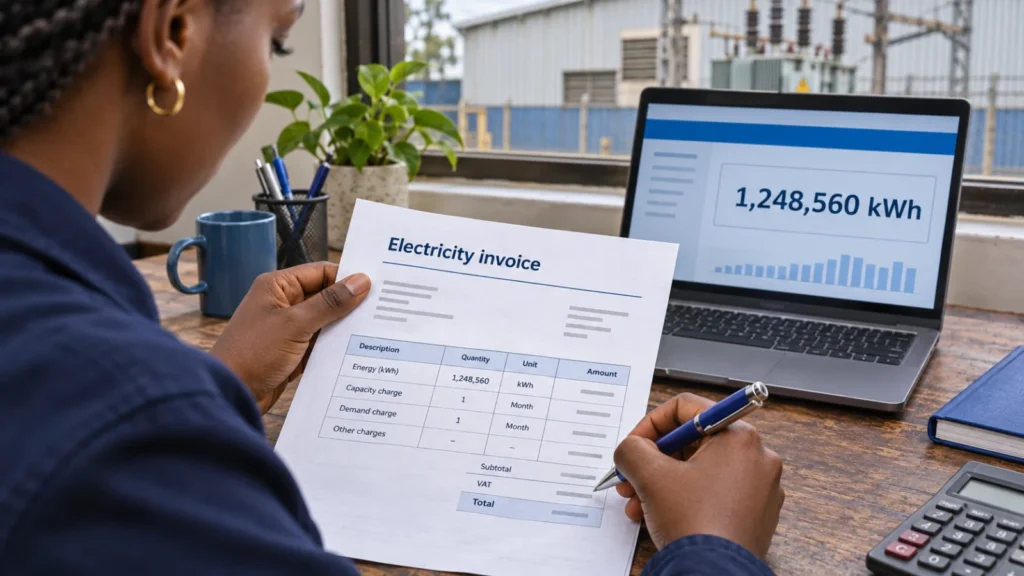
An illustration, with example figures only: a factory contracts for at least 150,000 kWh a month at KSh 14. Its producer passes on a network charge of KSh 2.50 a kWh. In October the factory takes 120,000 kWh.
| Line | Basis | Amount |
|---|---|---|
| Energy | 120,000 kWh x KSh 14 | KSh 1,680,000 |
| Shortfall to the minimum | 30,000 kWh x KSh 14 | KSh 420,000 |
| Network charge passed on | 120,000 kWh x KSh 2.50 | KSh 300,000 |
| Invoice | KSh 2,400,000 |
Three lines, each traceable to a reading or a contract term. That is the invoice a customer’s finance team will approve without a phone call.
Invoices a finance team will accept
Business customers pay from finance departments with processes of their own. They want an invoice with their details, a reference they can quote and a monthly statement they can reconcile. Many will also ask for eTIMS invoices for their records.
Collections and credit control
Large customers pay by bank transfer or RTGS, sometimes in parts, sometimes late. Each payment has to be matched to the right invoice as it arrives, not at month end. A deposit or bank guarantee per customer keeps one slow payer from becoming a cash-flow problem. So do reminders that stop when a bill clears, and a view of who owes what since when.
Reconciliation against what left your meter
Set what left your generation or boundary meter against what your customers were billed. The gap is losses, metering faults or a customer billed on the wrong reading. Seen every month, it is a short investigation. Seen at year end, it is a write-off.
Build it or start from a billing core
A spreadsheet holds up for two or three customers. Past that, the work is the same every month for every customer, and the risk is in the retyping.
You can build billing from scratch, but most of it is not specific to electricity: customers, meters, tariffs, invoices, payments, statements and reminders. What is specific is the contract logic and the link to your meters. Producers that also run mini-grids add mini-grid billing for homes on prepaid meters, with tokens from their vending server.
That is how we approach it. BillGrid, our billing product, already runs metered billing, contracts and collections for water, waste and internet providers. We build it around power suppliers on request: your tariffs, contracts, meters and the systems you keep. Where a producer needs more than billing, we build custom systems around how it runs.
What to do while the rules are finalised
- List the eligible consumers you could supply, their sites and loads, and how their meters are read today.
- Draft your contract terms around the bulk supply agreement format: tariff, duration, maximum capacity, metering and any commercial terms you add.
- Read your wheeling agreement for who carries the network charges, and decide how they appear on your invoice.
- Choose where meter readings will come from, and test one month of real data end to end.
- Work out how you will collect: bank details, references, deposits or guarantees, and who chases a late payment.
When the rules are final, the producers who can send a correct first invoice will have an easier time keeping the customer than the ones still building a spreadsheet.
Need it built properly? A free 30-minute call with an engineer, then one fixed price in writing.
Book a free call