Build vs Buy Operations Software in 2026: An AI-Era Guide for Kenyan SMBs
How to decide whether to buy SaaS, configure a platform, AI-build, or commission custom software - with the new economics AI introduced in 2025-2026.
By Jay Kiharani
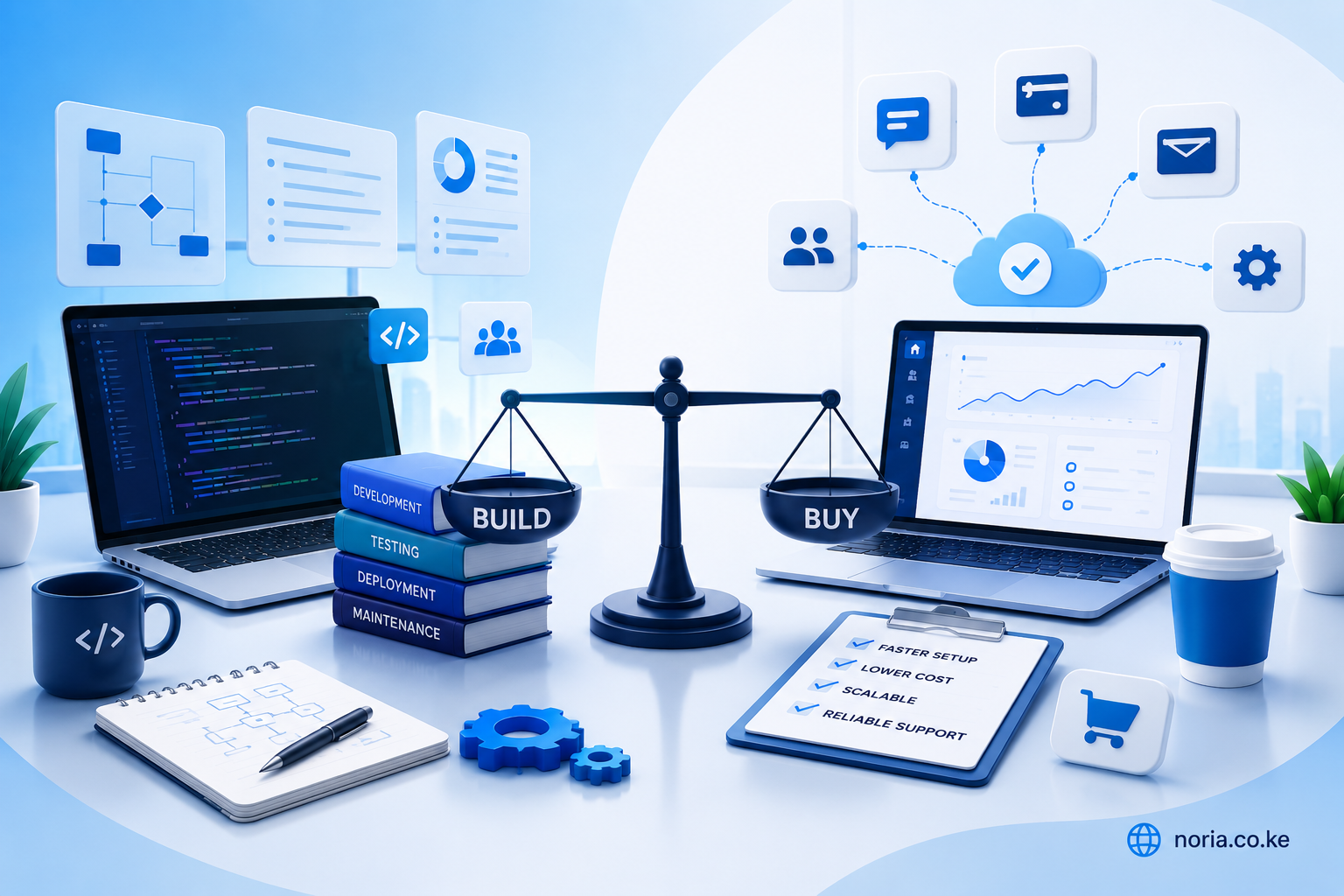
The most expensive software decision a Kenyan SMB makes is usually not the price of the software. It is the choice between options that all look reasonable up front - but bend the business in different directions over the next three years.
In 2024 the choice was: buy SaaS, configure a generic platform, or commission a custom build.
In 2026, AI added a fourth option that has changed the math considerably: AI-augmented building with tools like v0, Lovable, Bolt, Cursor, Replit Agent, and Claude Artifacts that let a non-engineer ship working software in days.
Get the choice right and the business runs smoother for years. Get it wrong and you pay for it every month - sometimes in cash, sometimes in workarounds that consume your team. Here is how to think about it clearly in the AI era.
The four real options in 2026
Option 1: Buy off-the-shelf SaaS
Sign up to a product built for your category - POS, school management, CRM, accounting. Pay a monthly fee per user or per transaction.
Best when: your workflow looks like everyone else's in your industry, the product is mature, and you have no unusual requirements.
Where it breaks: when "almost fits" becomes "consumes the team in workarounds". When the product is built for a different market (often US or UK) and the Kenyan reality - M-PESA, local taxation, local payment cycles, KRA, NSSF, NHIF - does not fit cleanly. When per-user pricing scales faster than your revenue.
Kenya-aware options that have emerged: Vendease (procurement), Kwara (SACCOs), Lipa Later (BNPL), Workpay (HR/payroll for African teams), Pesapal (payments) - these increasingly understand the local context out of the box.
Option 2: Configure a generic platform
Use a low-code or no-code platform (Airtable, Notion, Google Workspace, Zoho One, Bubble) as the operating layer. Configure it heavily for your workflow.
Best when: the workflow is still settling, you need to move fast and iterate, the team is comfortable with software, and the platform has the integrations you need.
Where it breaks: when the platform's data model starts fighting yours. When performance degrades as the dataset grows. When you cannot do something specific the business genuinely needs and the platform refuses to bend. The "I can build it in Airtable" excitement often becomes the "we are paying KES X per month and still doing the hard parts in spreadsheets" reality.
Option 3: AI-augmented build (new in 2025-2026)
Use AI builders (v0.dev, Lovable, Bolt, Replit Agent, Claude Artifacts, Cursor + LLM agents) to scaffold custom software in hours, not weeks. Iterate by describing what you want. Deploy with one click.
Best when: the workflow is straightforward, the data model is small, you (or someone on the team) is comfortable describing requirements precisely, and you do not need bullet-proof reliability from day one.
Where it breaks: when the system needs to integrate with M-PESA, WhatsApp, KRA, or anything beyond standard CRUD. When edge cases, security, compliance, or production reliability matter. When the AI generates working code but no one on the team understands it well enough to fix it when it breaks. When you need a system, not a prototype.
The AI builder honest truth
AI builders are extraordinary for prototypes, internal tools, and proof-of-concepts. They are not yet reliable for production-grade systems that handle money, customer data, or compliance. Most failure modes are silent: code looks like it works, ships, then breaks at scale or under edge conditions nobody tested.
Option 4: Commission a custom build
Pay engineers to build software specifically for your workflow, your team, and your data. You own the result.
Best when: your workflow is your competitive advantage, the business depends on the system day-to-day, off-the-shelf options have proven inadequate, integration complexity is real (M-PESA, WhatsApp, multi-system), and you expect to keep the system for years.
Where it breaks: when scope creeps, when nobody owns ongoing maintenance, when the build is done by someone who disappears, or when the spec was wrong to start with. A bad custom build is the worst of all four options.
What changed in 2026: custom builds are materially faster and cheaper than they were in 2023, because AI augments the engineers building them. The same team ships in 6 weeks what used to take 12.
The honest decision tree (2026 edition)
Does an off-the-shelf product genuinely fit at least 80% of your workflow?
- Yes -> buy it. Stop reading. Even if you have to adapt the other 20%, you are usually better off than custom-building the 80%.
- No -> continue.
Is your workflow still changing month-to-month?
- Yes -> configure a generic platform (Airtable / Notion / Zoho One). Custom-building a workflow that is still moving is expensive and you will rebuild it anyway.
- No -> continue.
Is this an internal tool with no integration complexity, no compliance requirements, and you (or your team) are comfortable iterating with AI?
- Yes -> AI-augmented build. Get a working version in days. Replace later if it outgrows the approach.
- No -> continue.
Is the workflow important enough to the business that bad software actually costs you money - in lost orders, wasted staff time, compliance risk, or customer churn?
- Yes -> commission a custom build. The math almost always works out, especially in Kenya where M-PESA, WhatsApp, and compliance realities make off-the-shelf fits worse than they look. With AI-augmented engineering, the cost is roughly half what it was in 2023.
- No -> revisit option 1 with a wider tolerance, or option 3 if no SaaS exists.
The Kenyan-specific factors most build-vs-buy guides miss
International build-vs-buy advice often assumes things that are not true in Kenya. The factors that change the calculation here:
Local payment realities
If M-PESA reconciliation is central to your business, almost no international SaaS will handle it properly. They either treat it as a one-off custom field, ignore it, or expect you to reconcile manually. For payment-heavy workflows, building (or configuring with serious M-PESA work) usually wins. We covered the M-PESA depth in our M-PESA integration guide.
Mobile and connectivity assumptions
International products assume reliable broadband, large screens, and continuous connectivity. Your customers - and often your staff - are on phones with intermittent connectivity. SaaS that does not work offline or on slow networks will get worked around. The workarounds are where the cost hides.
Local labour cost vs license cost
A SaaS that is reasonable in USD per user can be expensive when your team is six people earning Kenyan salaries. The break-even point for custom is closer than the standard advice suggests, especially when license costs grow with headcount. AI-augmented building shifts this further - a 6-week custom build can land at 12 months of SaaS license cost.
Tax, compliance, and audit
KRA requirements, eTIMS (mandatory electronic tax invoicing rolled out for VAT-registered businesses), NSSF, NHIF, SHIF (the 2024 successor to NHIF), and local audit conventions are rarely first-class in international SaaS. The cost of bridging is real and recurring.
Data protection (Kenya DPA 2019)
The Kenyan Data Protection Act has real teeth in 2026. SaaS hosted entirely outside Kenya/EAC and lacking proper DPA-compliant data processing terms can create compliance exposure. Custom builds can be hosted in-country and audited; some SaaS make this difficult.
What this looks like in practice - common mistakes
We see businesses make the same four mistakes:
- Over-buying. Subscribing to a powerful SaaS with 80% of features unused, paying for users they do not have, and still maintaining spreadsheets on the side.
- Over-configuring. Spending six months turning Airtable or Notion into something it was not designed to be, then hitting a wall and having to rebuild anyway.
- AI-build overconfidence. Shipping an AI-generated internal tool, then discovering at month three that it has no error handling, no audit trail, and no one to fix it. Then commissioning a full custom rebuild - paying for the work twice.
- Under-scoping the custom build. Commissioning custom software without writing down the workflow first, then watching scope, cost, and timeline expand.
The right answer is usually the boring one: buy where the fit is genuine, configure where the workflow is still moving, AI-build for cheap internal tools, build custom where the workflow is your business.
When AI-augmented building is actually the right answer
To be specific - AI builders work well for:
- Internal tools and admin dashboards that read/write a single database and have a small user base
- Marketing landing pages and microsites that need to ship fast
- Prototypes for stakeholder review before committing to a custom build
- Form-heavy workflows with straightforward data validation
- Reporting dashboards that aggregate existing data
They struggle with:
- Payment integrations that need idempotency and reconciliation
- WhatsApp Business Platform integrations with template management
- Multi-tenant systems with role-based access
- Anything touching KRA, eTIMS, or compliance reporting
- Workflows with audit trail requirements
- Production systems that cannot fail
A useful pattern: AI-build the prototype to validate the workflow with stakeholders, then commission a custom build of the production version. You spend 1 week on the prototype instead of arguing about specs for 4 weeks. Then you build the real thing with confidence.
How to start
If you are not sure which path is right, do this before talking to any software vendor or AI builder:
- Write down your actual workflow. One step at a time. Who does what. Where data lives. Where things break today. Be honest about the messy parts - the WhatsApp handoffs, the spreadsheet exports, the manual reconciliation.
- Be honest about volume. Customers per month. Orders per day. Staff using the system. Growth rate. Peak load times.
- Identify the constraints that are real. M-PESA, WhatsApp, KRA/eTIMS, SHIF, audit, multiple branches, intermittent connectivity, particular reporting needs.
- Decide what would be a disaster. If the system fails for a day, what happens? If data is wrong for a week, what happens? This shapes the option ruthlessly.
- Then evaluate. With that document, you can compare options without being sold to - by us, by SaaS vendors, by AI tool marketers, or by anyone else.
Need a second opinion before committing?
Our AI Implementation Audit is a 1-2 week engagement specifically for this question: where AI would actually help, where it would not, build-vs-buy recommendations, risk flags, and rough cost estimates for each option. No pitch - honest assessment. Most businesses save more than the audit cost in the first month by avoiding the wrong direction.
When to call us
If you would like a second opinion before committing to any path, we run scoping calls specifically for this decision. We will tell you honestly which of the four options fits - including telling you to buy off-the-shelf when that is the right answer for your business, or to AI-build the prototype before committing to engineering.
There is no one right answer. There is a right answer for your situation, and a wrong answer that costs you 18 months of progress. Book a call and we will help you find the right one.